Wednesday, 9 October 2019

Important Applications of Microbiology:

October 09, 2019 0
Important Applications of Microbiology:
Microbiology and pharmaceutical research

Some of the considerable applications of microbiology are as discussed below
:
Microbiology is one the main branches of applied sciences. It exceptional applications in the field of medical microbiology, soil microbiology, food microbiology, water and wastewater microbiology, extraction of metals, microbial technology, industrial microbiology and environmental microbiology containing applications of microorganisms as biosensors are discussed as fellow:
1.                Systematic study of Microorganism:
It give us the information about various types of microorganisms which enables us to reveal their structural and functional aspects, identifying and differentiating them, their classifications, naming, essential needs regarding their nutrition, to isolate and purify them as pathogens of plant and human, to develop phylogenetic relationships (relationships of various developmental stages during the evolution of an organism) and to interpret the origin of life itself.
systematic study of microorganisms

2.              
Microorganisms as a source of food:
Besides edible fungi such as mushrooms, microorganisms are also now used in the production of single cell protein in the form of bacteria, cyanobacteria, yeasts, and fungi as animal feed or human food. Japan, Mexico, Taiwan, Thailand, Israel, and America produces algal microbes on large scale. Various microbe synthesizing products are now utilized as human food such as cellulose or lignocellulose. Animal feed are also based on different microbial products.

3.              Fermented Food Products:
 Microorganisms are utilized in the manufacture of a large number of fermented foods such as sourdough bread, leavened bread, flavours and fermented milk products. The fermented milk products include cheese, yoghurt and many other products.
Fermentation by microorganisms
4.              Fermented Vegetables:
 The important fermented vegetables are sauerkraut that is obtained from cabbage and Kimchi obtained from fermented vegetables in Korea.
Various fermented vegetables

5.              Fermented meats and Fermented Fish:
Fermented fish and fermented meats are utilized in various parts of the world because of their increasing retentivity, otherwise the fish and meats are extremely perishable.
6.              Fermentation and Beverage Products:
Beer, rice wine, tempeh, vinegar, soya sauce too are fermented products.
7.               Preservation of Food:
Microbiology has been playing vital role in preservation of food by appertization and pasteurization that is commercially sterile food and by heat processing, prevention of spoilage of canned food, irradiation, aspectic packaging, ionizing radiation, UV radiation, high pressure processing that is low temperature storage, pascalization and chemical preservation ( esters, organic acids, sulphur dioxide and nitrites).
Food microbiology gives the tools for prevention of food borne illness caused by bacterial and non-bacterial agents. The food borne illness agents among the nematodes and helminthes are Platyhelminthes that are tapeworms and liver flukes and roundworms such as Trichinella spiralis. Among the protozoa, the agents that are causing food borne diseases are Entamoeba histolytica and Giardia lamblia.
Various Food Preserves

8.              Microbial Diseases:
Microorganisms are the leading cause of several diseases which are spreading worldwide and causing serious health issues. Microbiology provides a number of tools for the treatment and control of such diseases.
Cholera vector illustration

9.             
Industrial Microbiology:
Various products obtained from microbial metabolism after microbial processing of raw material have been produced on industrial scale. These include high value drugs, chemicals, fuels and electricity.
Microbiology in different industrial processes

10.       
Microbes as a Source of Enery:
Several substrates can be utilized as a source of energy such as methanogenic bacteria are source of biogas. The methanococcus and methanobacterium produce methane gas by utilizing CO2 as an electron acceptor. In japan, for the faster production of methane gas, a new specie of methanobacterium has been evolved that is M. cadomensis 23 strain. Ethanol can also be utilized for the manufacture of gasohol by mixing 20 percent ethanol and 80 percent gasoline.
11.           Degradation of cellulose and lignin:
Trichoderina reesei can be utilized degrading cellulose because it is producing extracellular cellulase. The white rot fungus Sporotrichum pulverulentum which is a cellulase negative organism, whoever a mutant of it has been produced which can degrade wood and kraft lignocellulase actively. Now biological pulp has been produced in the absence of any chemical treatment for delignification
12.         Mining and Extraction of Metals:
Pyrite (FeS2) and chalcopyrite (CuFeS2)  can be degraded by utilizing Thiobacillus ferroxidants and a combination of Thiobacillus organoparpus and Leptospirillium ferroxidants. Iron and sulphur can be oxidized by using archaeal species S.brierlevi and Sulfolobus acidocaldarius that depends on CO2 or other simple organic compounds for energy. These archeobacterial specie can also degrade chalcopyrite (CuFeS2) and Pyrite (FeS2).
Metal extraction process

13.         Recombinant DNA and genetic recombination:
Manufacturing and manipulating genetic material in vitro that is genetic engineering has produced extremely wonderful products such as Recombinant DNA. The genetic recombination is the process of joining DNA from various sources. Different microorganisms have been used to isolate several number of restriction enzymes and restriction endonucleases that have the abilities to cleave or cut double stranded DNA leaving staggered ends.
DNA cutting and manipulation

14.         Hybridoma and preparation of monoclonal antibodies:
A cell which is made by combining antibody-producing B cell with a cancer cell is called as Hybridoma. The resulting hybridoma cells or myeloma contain properties of both parent cells immortality and can also secrete considerable amount of a single specific type of antibody. This phenomenon was discovered by Kohler
15.           Harvesting DNA biotechnology for various public health engineering programmes:
These programmes include manufacturing of an antiviral protein that is interferon prepared by specific animal cells in response to a viral infection, production of somatotrophin that is a human growth hormone, production of human insulin and production of several other vaccines and hormones
The vaccines for diphtheria, cholera, tetanus, viral hepatitis type A and type B, pertussis, influenza, plague, mumps, measles (rubella) poliomyelitis, rabies, typhoid, typhus, rubbela,  and yellow fever have been prepared so far.
16.         Microbes as Biofertilizers:
Microbial technology of nitrogen fixation exploiting symbiotic
Microbial technology involves the nitrogen fixation by symbiotic microoganisms having association with higher or lower plants and nonsymbiotic or asymbiotic relationship that involves the nitrogen fixation by microorganisms independently. The main enzymes that are responsible of converting molecular nitrogen to ammonia involves nitrogenases.
17.          Making smarter and faster computers:
The Archaeobacterium Halobacterium halobium are growing in nature in solar evaporation ponds that have excessive concentration of salts. These salty ponds are present around San Francisco Bay located on the Western coast of USA.
It has been investigated that when the cell of Halobactrium halobium is broken down, it fragments into two main fractions which are red and purple in colour. The purple fraction plays important role in manufacturing computer chips. The protein which is responsible for purple colour is referred to as bactriorhodopsin.
Robert Birge at Syracuse University’s Centre of Molecular Electronics has grown Halobacerium halobium in 5-litre batches and has extracted the protein bacteriorhodopsin from the cells and developed the computer chips which are made up of a thin layer of bacteriorhodopsin.
The chips that are prepared from bacterial sources have the capacity to store more information as compared to conventional silicon chips and can process the information as fast as human brain. These chips must be stored at -4°C.
DNA chip: DNA micro-array


Monday, 7 October 2019

A Review Article on Electricity Generation from Solar Energy

October 07, 2019 0

A Review Article on Electricity Generation from Solar Energy

Abstract:

The solar energy produced by sunlight is renewable non-vanishing source of energy which is eco-friendly. The solar energy can be used to meet the energy demands of the world for a whole year. This solar energy is produced as per its demand in commercial, industrial and residential fields. It can easily be generated directly from sunlight. So it is very efficient and not associated with any environmental pollution. This review article is concerned with the solar energy from sunlight and its future aspects and trends. The article also tries to cover the working and types of solar panels and their applications and also various methods for promoting the benefits of solar energy.
Keywords: Renewable energy, Photo-voltaic cell, Solar panel, Modelling of PV Panel, Solar Concrete Collector

I. INTRODUCTION

The last ten years have become more important for per watt cost of solar energy device because of decreasing amount of renewable energy sources. It is growing as better technology in terms of cost as well as applications and certainly set to become economical in the coming years. The sunlight that earth receives every day is approximately above 1366 W. So an unlimited source of energy is available without any cost. The solar energy also has major advantage over other conventional source of power generations that it can be produced directly from sunlight by using smallest photo-voltaic cells. A large number of research activities have been carried out to develop solar cells, panels, and modules with high converting forms. Furthermore, solar energy demands lower manpower expenses as compared to conventional energy production technologies.

 II. SOLAR ENERGY

The amount of energy present in the form of radiations and heat is termed as solar energy as shown in fig.1. The heat and the radiant light from the sun is a natural source of energy based on a wide range of ever changing and developing technologies such as solar architecture, solar thermal energy, molten solar power plant, solar heating and artificial photosynthesis. The availability of solar energy on large magnitude provides highly appealing source of electricity. Only 30% of solar energy is returned back to space while the rest solar radiations are absorbed by clouds, ocean and masses.
Figure 1 Internal of Reaction of Solar energy

III. WORKING OF SOLAR ENERGY

Sunlight is converted to Direct current electricity by photovoltaic cell PV. The power from solar panel is controlled by charge controller which controls the power from reverse back in order to avoid panel damage. The electric power stored in battery is used in the absence of sunlight such as at night. Inverter connected to this system converts the Direct current (DC) into Alternating current (AC).
Figure 2 Working of solar energy-
Figure 2 Working of solar energy

IV. MODELING OF PV PANEL

A. Solar Cell (Photovoltaic Cell)

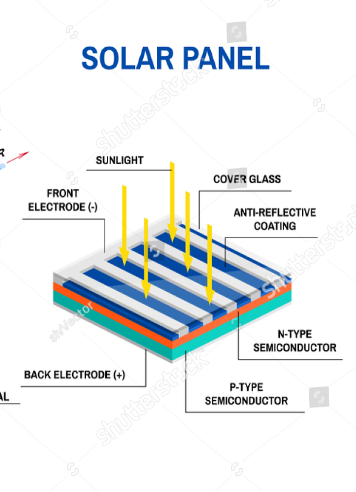
Photovoltaic cells converts the solar radiations directly into electricity. It composition contains different kinds of semiconductor materials.  It may be of two types based on either positive charge or negative charge as shown in fig.1. Low cost and high conversion efficiency can be achieved by designing solar cells based on this cell technology. The photons of sunlight absorbed by the cell knocked out the electrons from silicon atom and are absorbed by a grid of metal conductors and produces a flow of electric direct current. Solar cell PV are composed of various chemicals.
 Operation of Photovoltaic Cell
Figure 3. Operation of Photovoltaic Cell

B. Photovoltaic Module

Solar cell circuits are sealed in an eco-friendly laminate and are the basic building blocks of PV system. Their general sizes are from 60W to 170W. Generally, the arrangement involves a large number of PV modules in series and parallel to fulfil the energy requirements.

C. Photovoltaic Panel

It consists of one or more PV modules arranged as a pre-wind, field instable unit. In this panel the arrangement of PV cells are in series connection. Solar panels are composed of individual PV cells that are linked together.
Figure 5. Photovoltaic Panel

D. Photovoltaic Array

It consists of several number of PV cells in parallel and series connection. Voltage of the module is increased by series connection whereas current in the array is increased by parallel voltage. During full sunshine, it can generate maximum 180W. The production of solar electricity is directly related to the total surface area. Greater the surface area, greater will be the production of solar electricity.
Figure 6. Photovoltaic array

V. SOLAR CONCRETE COLLECTORA. PARABOLIC TROUGH REFLECTORS

It consists of linear parabolic reflector that concentrates light onto a receiver that is positioned along the focal line of the reflector. It contains a receiver that is a tube placed directly above the middle of the parabolic mirror and fluid that is working fluid. When working fluid flows through the receiver, it is heated at 150-350 degree Celsius and then used as a source of heat for power generation system.
Figure 7 Parabolic Trough Reflectors
Figure 7. Parabolic Trough Reflectors

B. Fresnel

In a Fresnel lens, the surface is designed to produce refraction, while the large material between the two surfaces does not have any hindrance in the refraction. It has role in raising the temperature further and also in heating of furnace. The surface modification of metallic material can be out by its installation. The application of solar energy in the field of high and very high temperature can be carried out by this equipment. This equipment can achieve that temperature within a few seconds. The reflective area can be reduced by 34.3% by Fresnel concentrator as compared to a parabolic of same diameter. The manual adjustment in order to track the sun requires a 20 minutes series of action and has been proved to be a major disadvantage with this device.1888
Fresnel Reflector
Figure 8. Fresnel Reflector

C. Parabolic Dish

It is identical in appearance to a large satellite dish, but contains mirror like reflectors and absorber working as the focal point. It utilized dual axial sun tracking. The efficiency of 30% can be achieved by it. MW level in the solar planet has been produced by this dish. This is one of the highest conversion performance of the concentration solar power technology.
Figure 9 Parabolic Dish
Figure 9. Parabolic Dish

D. Central Receiver

It usually utilized in large scale plants that are generally generating the more amount power. It also termed as “Power Tower”. It works by focusing a field of thousand number of mirrors on to a receiver positioned at the top of a centrally located Tower. The receiver receives the sun’s heat transfer fluid, which is employed to generate stream turbine positioned at the foot of the tower for generation of Electricity.
1889

VI. MERITS OF SOLAR ENERGY

Up to 20% of the energy cost can be saved by using solar energy. It can be employed in remote locations. It has easy installation without requirement of any cords, wires etc. Rooftop is used for its generation and there is no need of new and every commercial or domestic user can generate their own electricity. It is generated from the widely available sunlight without any cost, eco-friendly and renewable energy source. It does not need any additional fuel, because it does not has any additional moving parts other than sunlight to generate power. It does not has any need of fuel and water.

VII. DEMERITS OF SOLAR ENERGY

It cannot generate power in the absence of sunlight. It has high initial cost. It needs more space to generate large amount power. Inverter is required for alternating Direct current and also its storage is required at night. The production of PV systems having single silicon crystals is challenging technically and energy and time consuming.

VIII. APPLICATIONS OF SOLAR ENERGY

.
It is utilized in many applications including
Ø electricity
Ø evaporation
Ø heating water
Ø heating and cooling of buildings
Ø water pumping
Ø cooking food etc.
Figure 11 Application for heating water Figure 12 Application for Water pumping Fig.13.Application for cooking food

IX. CONCLUSION

Solar energy is now becoming more popular because of its economic benefits. Solar energy can give electricity 24x7, even at night and on cloudy days by on battery backup. Continuous power supply can be managed by using with inter-grid system. It has more benefits in comparison to various other forms of energy such as petroleum deposits and fossil fuels. It is an alternative which is consistent and promise in order to fulfil the high energy demand. Research on solar energy and solar cells is on the way for further future perspectives worldwide.

REFERENCES

[1] Shruti Sharma, Kamlesh Kumar Jain, Ashutosh Sharma a review on “Solar Cells: In Research and Applications”,Materials Sciences and Applications, 2015, 6,1145-1155 Published December 2015 http://dx.doi.org/10.4236/msa.2015.612113
[2] Askari Mohammad Bagher, Mirzaei Mahmoud Abadi Vahid, Mirhabibi Mohsen. “Types of Solar Cells and Application”. American Journal of Optics and
Photonics.Vol. 3, No. 5, 2015, pp. 94-113. doi: 10.11648/j.ajop.20150305.17
[3] Book of “Wind and Solar Power Plants” by Mukund Patel, CRC Press
[5] Book of “Solar Energy” by Dr. S. P. Sukhatme. Tata McGraw Hill Publication.
[6] Gaurav A. Madhugiri, S. R. Karale, “High solar energy concentration with a Fresnel lens: A Review”Vol.2, Issue.3, May-June 2012 pp-1381-1385 ISSN: 2249-6645.

Friday, 27 September 2019

Child Education Plan and Leading Life Insurance Companies

September 27, 2019 0

Child Education Plan and Leading Life Insurance Companies

Life Insurance
Life Insurance

Securing Your Children’s Future through a Child Education Plan


You can secure your own future by securing the future of your children. The future of children is safe when parents are around them but there are some instances that the parents may not be present and their absence could them financially unstable. A child’s education plan will furnish security on financial level at a time that matters.
The biggest dream of most of us is to support our child’s education and to send them in best schools, colleges and universities. But in the last few years, the cost of child’s education has gone skyrocket and even increasing day by day. Therefore it is must to make a plan for securing child’s education in order to secure his future.

Life Insurance Companies offering a Child Education Plan in Pakistan


The leading life insurance companies that offer s child education plan are highlighted below:

1.     Child education plan by Jubilee Life Insurance

2.     Child education plan by State Life Insurance

3.     Child education plan by EFU Life Insurance

4.     Savings plan for college education by IGI Life Insurance

5.     ABC Education plan by Pak Qatar Family Takaful

6.     Education secure plan by United Insurance Company


Types of Child Education Plans

The child education plans offered by the above mentioned leading insurance companies are fall in one or another category as discussed below. These plans are associated with insurance and investment options as part of the policy. This then makes it facile for you to manage the amount and the dates of any future payment related to policy of your child.

Regular Premium Plan: 

This plan involves to pay premiums till the time to reach the child of 18 years age. After that, the insurance company is responsible for paying the recipient the total amount throughout the coming years.


Single Premium Plan:

These plans includes a lump sum being paid once the policy gets to maturity.


Unit-Linked Child Plan: 

There are various advantages that are associated with these plans in addition to good returns. They provide a number of withdrawal options and offer the exact level of cover that provides high returns in addition to over time, the value increases.


Money Back Plan:

These plans provide well organized way to plan and can be used as child plan. They are outlined to fulfil the future expenses of the individual as well as providing a regular income option.


Endowment Plans:

These plans bring together the excellence of investment and insurance plans. After an agreed duration of time, the investment feature of the plans come into effect. At the ending of the endowment period, you will also accept a lump sum, facilitating it a right option for securing the future of your children.

A Review of State Life Insurance Child Education


State Life Insurance Policy for Child Education enables you to give best start to your child in their adult life and so it is considered to be the most important plan for all involved. The plan provides a lump sum cash benefit for your children after the completion of overall terms of policy.

Main Features of State Life Insurance Child Education:

The aim of the plan is to provide a lump sum facility for the child after the completion of the policy term. After the completion of the term, the full insured amount in addition to accrued bonuses are paid to the policyholder.
Somehow, the policyholder may be passed away before the completion of policy term, then the child will be provided with a family income benefit to the sum of Rs 240 per 1000 sum insured on an annual basis up to point where the policy term ended. All the future premiums that are part of the policy are waived as a policy benefit to the policy holder’s family and at the same time the policy stays in place having full sum insured to continue to become a part of surplus of State Life and receive bonuses. So when the policy comes to completion, the child is offered with two options to choose from. This includes to receive the proceeds in one lump sum or to receive it in instalments.
 The same policy can also be continued in the same manner through switching the plan to avail benefit for another child. However it is more beneficial to continue the contract rather than to refund all the previous premiums paid up to the death of the policy holder. It is also possible to continue the policy without the need to name another child. However the option of refunding will not be available at this point.

Benefits Offered by Child Education Plan:

The child education plans are the ideal plans for those parents who want to secure their children education and career life by providing with a good financial support.
The lump sum benefits will be paid to the children, when they reach their predetermined age of either 18, 21 or 25 years old. This option enables the parents to select an age that is the most suitable time in their life when they are probably in need of money for entering in education or even going into business.
The plan can modified according to the specific needs because there are two versions available for choice. The first version offers built-in family income benefit while the other comes without family income benefit. In addition to parents, the plan can also be guided by uncles, grandparents and all other family members who are helping to cover the costs of maintenance for the child.
A surrender value will be given to the plan after effectiveness of plan for consecutive two years providing no payments have been missed. This surrender value will be given by the State Life on the official request of the policyholder.

 Eligibility criteria for getting a Child Education plan:

 There are some specific eligibility criteria in order to issue that plan and put in place. The person as policy holder should have minimum age of 20 years while the maximum age of policy holder is 60 years. However the maximum age should be 70 the plan comes to the maturity.
To plan for the secure future of your children is important and this plan enables you to do just that provided by the state owned largest life insurance company in Pakistan called State Life Insurance company. Having a vast range of benefits, it is an extraordinary option for parents to give their children the best start in life. This is a plan that provides flexibility in the way of working and that refers that parents can be confident in all that it has to provide.
You can make it sure to get best education plan for your child through Mawazana.com before buying a plan in Pakistan.


“Mawazna Karein Apne Liye, Apno key Liye”